



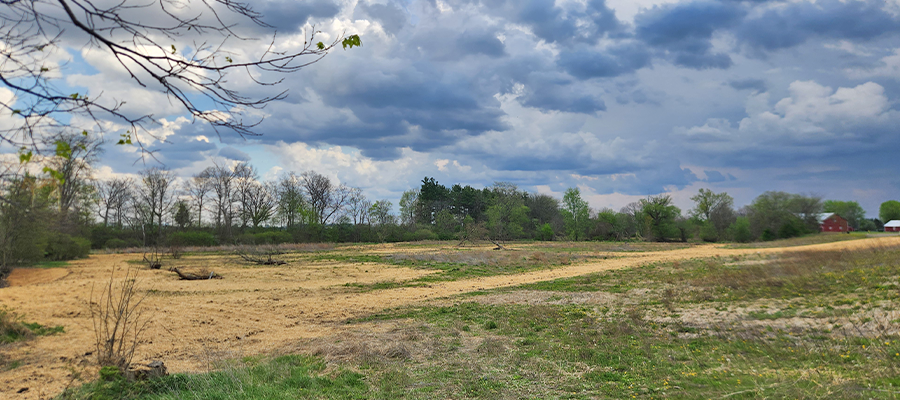
 In Northwest Ohio, farmland and aquatic ecosystems are deeply connected. What happens on the land ultimately influences the streams and rivers that carry water toward Lake Erie and how wetlands and floodplains store water, nutrients, and sediments.
Along Toussaint Creek in Ottawa County, Ohio, the Schlievert Floodplain Restoration project is demonstrating how those connections can be managed differently.
EnviroScience, in partnership with RiverReach Construction, recently completed design-build stream, wetland, and floodplain restoration for Black Swamp Conservancy’s Schlievert Floodplain Restoration project. Funded through the H2Ohio Program, the project was designed to improve water quality, restore habitat, and reconnect portions of the floodplain while allowing agricultural operations to continue on the surrounding property.
The result is a restoration project that demonstrates how environmental improvements and working lands can coexist.
Finding Opportunity Along Toussaint Creek
The approximately 35-acre project area included row crop fields, degraded floodplain meadows, and existing woods along Toussaint Creek.
Black Swamp Conservancy initially identified the property as a priority for restoration using its GIS-based land assessment model. The property owners, Warren and Rosemary Schlievert, had already recognized the environmental value of the land adjacent to the creek and removed portions from agricultural production.
That created an opportunity to take restoration further.
Rather than remove the entire property from agricultural use, the project focused on restoring critical portions of the floodplain while maintaining farming on the surrounding upland areas.
For EnviroScience, that meant developing a restoration approach that could meet ecological and water quality goals without interfering with ongoing farming operations.
Designing Restoration Around a Working Landscape
Restoration on privately owned, actively farmed land requires more than an effective engineering design. It requires communication.
Throughout design and construction, the project team coordinated closely with the landowners to ensure restoration activities would not negatively affect farming operations. EnviroScience also coordinated with Ottawa County for work within the petition ditch right-of-way and managed local floodplain permitting requirements because the project is located within a FEMA Zone AE (a high-risk area with a 1% annual chance of flooding) and designated floodway.
That coordination helped turn a restoration concept into a practical design suited to both the landscape and the people who depend on it.
EnviroScience engineers developed grading plans and quantities with project goals and budget in mind. Targeted grading and strategic spoil placement created a flow path through the floodplain, giving storm flows greater opportunity to move through restored wetland areas.
The approach creates more opportunities for water to move through and interact with the restored floodplain.
By slowing and redirecting flows through the floodplain and wetland complexes, the restored landscape can provide opportunities for nutrient reduction before water continues downstream through the watershed.
Building Habitat Into the Design
The completed project created 2.45 acres of wetland along with an additional 1.52 acres of hummock and hollow habitat.
Woody structures were incorporated throughout the site to provide habitat while helping redirect flows through the wetland complexes. The project team also identified an opportunity beyond the original restoration goals: two steep, eroding banks along Toussaint Creek.
In total, 233 linear feet of eroding streambank were stabilized through grading and woody branch layering, helping improve both water quality and habitat along the reach.
The project included 1,650 bare-root trees, native seeding, and invasive vegetation treatment across 16.67 acres. Another 100 live stakes were installed along the stabilized streambanks to provide additional long-term stability and habitat as vegetation becomes established.
Together, these elements are intended to create a more resilient and diverse floodplain system while addressing broader water quality and habitat needs.
A Collaborative Approach to Conservation
The Schlievert project also offers a broader example of what conservation can look like in agricultural landscapes.
Farmland preservation and habitat restoration do not necessarily need to compete with one another. By targeting the portions of a property where restoration can provide meaningful ecological benefits, projects can improve natural systems while preserving productive agricultural land.
That approach requires flexibility from everyone involved.
For the Schlievert Floodplain Restoration, Black Swamp Conservancy brought together the landowners, H2Ohio funding, and a vision for long-term conservation. EnviroScience and RiverReach Construction translated that vision into a design-build restoration project, combining engineering, wetland expertise, permitting and agency coordination, construction oversight, native planting, and invasive vegetation management.
Most importantly, the project was designed around the landscape rather than forcing the landscape to fit a predetermined solution.
From Working Land to Working Ecosystem
Wetland and floodplain restoration projects are ultimately about restoring function.
At Schlievert Farms, that means creating places for water to spread across the floodplain, slowing storm flows, providing opportunities for nutrient reduction, stabilizing eroding streambanks, and establishing native habitat, all while agriculture continues nearby.
It is a model that demonstrates what can happen when conservation organizations, landowners, engineers, restoration professionals, and funding partners work toward a shared goal.
The landscape can continue working for people while also working for water quality, habitat, and the watershed as a whole.
See the restoration for yourself. Watch Black Swamp Conservancy’s video tour of the Schlievert Farms wetland restoration project to learn more about the property, the restoration approach, and the partnership that brought the project to life.
Looking for support with wetland, stream, or floodplain restoration? EnviroScience brings together ecological expertise, engineering, permitting, construction oversight, and restoration services to help move projects from concept through implementation. Contact our team to discuss your next restoration project.
Few environmental firms in the country retain EnviroScience’s degree of scientific know-how, talent, and capability under one roof. The diverse backgrounds of our biologists, environmental engineers, scientists, and divers enable us to provide comprehensive in-house services and an integrated approach to solving environmental challenges—saving clients time, reducing costs, and ensuring high-quality results.
Our client guarantee is to provide “Excellence in Any Environment,” meaning no matter what we do, we will deliver on our Core Values of respect, client advocacy, quality work, accountability, teamwork, and safety. EnviroScience was created with the concept that we could solve complex problems by empowering great people. This concept still holds true today as our scientists explore the latest environmental legislation and regulations and incorporate the most up-to-date technology to gather and report data.
EnviroScience expertise includes but is not limited to aquatic surveys (including macroinvertebrate surveys and biological assessments); ecological restoration; ecological services (including impact assessments, invasive species control, and water quality monitoring); emergency response; engineering and compliance services; endangered mussel surveys; laboratory and analysis; stormwater management; sustainability services; threatened and endangered species; and wetlands and streams (including delineation and mitigation). Further, EnviroScience is one of the few biological firms in the country that is a general member of the Association of Diving Contractors International (ADCI) and offers full-service commercial diving services.