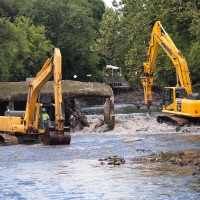
Figure 1: Successful 2024 Treatment
Jefferson, OH
- Client: Western Reserve Land Conservancy
- Key Services Provided:
- UTV and ARGO mounted spray tank application
- Backpack application
- Aerial drone application
- Project Duration: 2024-2025
- Acreage: 34 acres
- Target Species:
- Phragmites spp.
- Typha angustifolia
EnviroScience, Inc. led a qualified crew of vegetation service technicians to treat invasive reeds through thirty-four acres of Jefferson Swamp. The project was split into two treatment areas: Northern Cell and Southern Cell. The Northern Cell was treated via backpack and spray tank application due to the presence of live trees. The Southern Cell, a dense, mature monoculture of Phragmites spp., was treated via drone application.
Invasive emergent aquatic vegetation was foliar sprayed with an aquatic approved glyphosate-based herbicide at a mix-rate of 5% via low-volume backpack and high-volume spray tank application. All herbicides were mixed with an aquatic approved foliar-penetrating surfactant, and tracker dye. Equipment ranged from backpack sprayers to amphibious Argos to commercial drones.
Much of the invasive vegetation in the North Cell was embedded within desirable tree canopy requiring foliar applications with backpacks and tank spraying equipment. This was done to reduce the risk of overspray onto beneficial shrubs and trees. In total technicians treated fifteen acres.

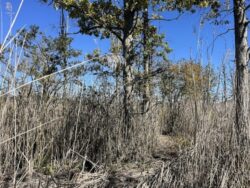
Figure 2: Regrowth
The Southern cell was treated by a licensed drone operator, using a high volume, 2% glyphosate mixture. This saved the client on both time and number of technicians involved, reducing the costs and shows EnviroScience’s commitment to enhancing technology and creating maximum efficiency. The Southern cell allotted the other nineteen acres of the project area. The same procedure was followed for the 2025 treatment. Most of the invasive vegetation was new growth from the seedbank. However, our efforts were clear with much of the area being recolonized by Decodon vertilicillatus, Bidens frondosa, Thelypteris palustris, Leersia oryzoides.